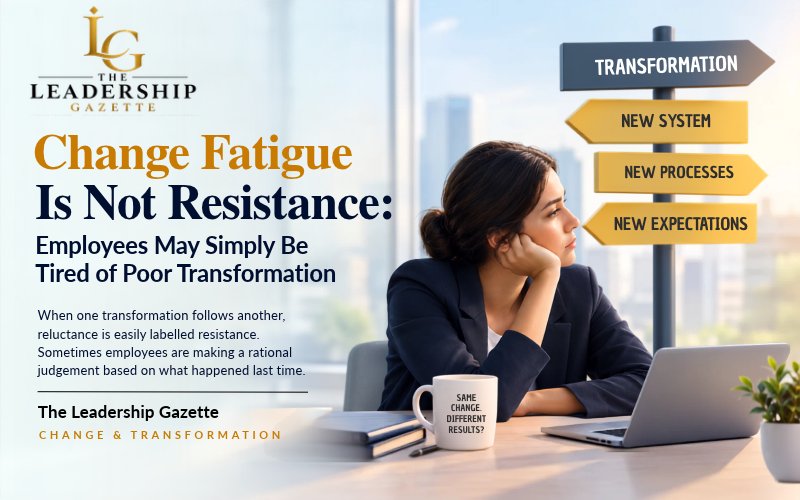
When one transformation follows another, reluctance is easily labelled resistance. Sometimes employees are making a rational judgement based on what happened last time.
People are not always resisting the future. They may be protecting
themselves from another badly managed journey towards it.
The language of transformation contains a convenient villain:
the resistant employee.
They are said to be attached to old ways of working, uncomfortable
with ambiguity or unwilling to embrace progress. Leaders are encouraged
to communicate more, identify champions and manage the resistance until
the organisation moves forward.
Sometimes that diagnosis is correct. Sometimes employees are tired because
the previous transformation is unfinished, the new system created more administration
, promised benefits never appeared and leaders who launched the initiative have already
moved on.
Gallup reported that 72% of employees experienced some form of organisational disruption
in the preceding year, with leaders and managers more likely than individual contributors
to report extensive disruption. Deloitte’s 2026 research found only 27% of
respondents believed their organisations managed change effectively. In that
environment, change fatigue is not a surprising employee defect. It is operational feedback.
Organisations remember the announcement; employees remember the aftermath
Transformation is usually narrated from the top. Leaders remember the strategy,
the launch and the milestone presentation. Employees remember the duplicate processes,
missing data, temporary workarounds and weekends spent correcting what the new system
did not handle.
This difference matters. When the next initiative arrives, leadership sees a fresh opportunity.
Employees see a pattern.
Trust is shaped less by the quality of the latest presentation than by whether previous
promises were kept. If leaders said a system would remove administration and it added
three approvals, employees are not irrational for questioning the next efficiency claim.
Not all resistance should be overcome
Resistance can contain useful information. Employees may understand dependencies the project
team has missed. They may know that a proposed process works in one country but conflicts
with regulation in another. They may recognise that a performance target will encourage
the wrong behaviour.
Treating every objection as an emotional barrier prevents the organisation from distinguishing
discomfort with change from evidence that the change is poorly designed.
The better question is not, ‘How do we reduce resistance?’ It is, ‘What is this response
telling us?’ Some concerns require explanation. Others require the plan to change.
The manager cannot repair a credibility problem alone
Managers are often instructed to maintain energy and reinforce the message. Yet they may have
little more information than their teams and no control over the decisions causing frustration.
Asking managers to communicate certainty they do not feel damages their credibility. Employees
can hear the difference between an honest explanation and a script.
Equip managers with decision context, boundaries and a genuine route for escalating operational
feedback. Allow them to say what is known, what remains undecided and what will happen next.
Trust does not require perfect certainty. It requires consistency and candour.
Change has a capacity cost
Most organisations budget money for transformation but not attention. They approve initiatives
separately even though the same employees must absorb all of them at once.
A finance transformation, restructuring, leadership change and new performance system may each
have a sound business case. Together, they may exceed the organisation’s capacity to learn and adapt.
CHROs need an enterprise view of change demand: which populations are affected, what behaviours
must shift, when pressure peaks and what existing work will be stopped. A transformation plan
that adds new expectations without removing old ones is not a plan. It is an accumulation.
Measure whether the change survives the project team
Projects often declare success at implementation: the technology went live, the training was
completed and the communication reached the workforce.
The meaningful test comes later. Are people working differently six months after the project team
leaves? Has cycle time improved? Are managers making better decisions? Did employees abandon the
workaround, or did the workaround become the real process?
Completion measures activity. Adoption measures behaviour. Value measures whether the behaviour
improved an outcome the organisation cares about.
Create stability without promising stillness
Employees do not need leaders to pretend that change will stop. They need help understanding what
will remain stable: the purpose, the principles for decisions, the commitments that will be honoured
and the priorities that can safely be ignored.
Deloitte describes a move towards continuous adaptability rather than episodic change management.
That idea will work only if organisations also learn to close, simplify and stop. Continuous
adaptation cannot mean permanent overload.
People can handle difficult change when it is coherent, honestly explained and competently executed.
What exhausts them is repeated disruption without resolution.
Change fatigue is not a reason to communicate the same message more loudly. It is a reason to examine
whether the organisation has earned the right to ask for belief again.