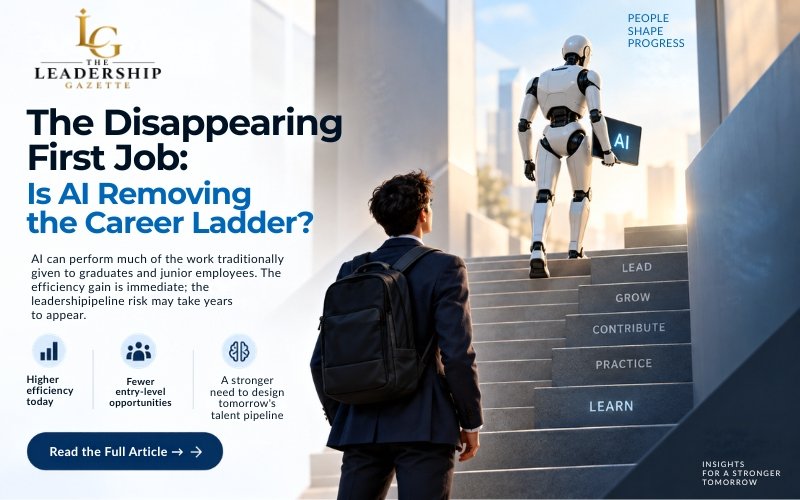
If the machine does the junior work, where does the junior employee learn?
The first job was never glamorous. It involved research, scheduling, first drafts, data cleaning, note-taking and the small assignments senior colleagues had outgrown. Much of it was repetitive. Some of it was frustrating. Almost all of it taught something.
Today, those are precisely the tasks generative AI can perform quickly and cheaply. A company can ask an AI system to draft the briefing, summarise the meeting, compare the proposals and prepare the initial analysis before a graduate has opened the file.
From a quarterly productivity perspective, the decision appears obvious. From a five-year talent perspective, it is far less comfortable.
The International Labour Organization’s 2026 youth-employment research estimates that 6.1% of jobs held by people aged 15 to 29 are in occupations highly exposed to AI-related change. The World Economic Forum has also warned that aggressive removal of entry-level work could damage the pipeline that produces future managers, leaders and institutional memory.
Efficiency has a time horizon
Most business cases for automation measure the work removed, the hours saved and the cost avoided. They rarely price the experience that used to be created while the work was being done.
A junior analyst learns by producing an imperfect first draft and seeing how a senior colleague changes it. A new recruiter learns by screening candidates, observing interviews and discovering why an impressive CV does not always predict success. A graduate in finance learns not only to reconcile the numbers but to recognise when something does not feel right.
These are not arguments for preserving low-value work indefinitely. They are reminders that development has often been embedded invisibly inside production. Once production is automated, learning must be designed deliberately.
The bottom rung supports the entire ladder
Organisations sometimes speak as if they can reduce junior hiring while continuing to recruit experienced talent later. That works only while another employer continues to train the people they will eventually hire.
If an entire market automates the same entry-level roles, the supply of experienced talent will narrow. Salaries for proven specialists may rise, internal succession will weaken and companies will become more dependent on a smaller group of people who acquired their experience before the pathway changed.
The risk will not appear in next year’s headcount plan. It will appear when a senior employee leaves and the organisation discovers that nobody has accumulated the judgement to replace them.
Young employees may use AI most—and still lose most
Early-career employees are often enthusiastic users of AI. They can produce work at a level that once took years to reach. But polished output can conceal shallow understanding.
If a young employee can generate a sophisticated market analysis but cannot explain the assumptions, challenge the sources or recognise an implausible conclusion, the organisation has accelerated production without accelerating capability.
Managers must resist rewarding only the quality of the final document. They need to examine how the employee reached the answer, what judgement they applied and what they would do if the technology were unavailable or wrong.
Redesign the apprenticeship, not the old administration
The answer is not to create artificial busywork. It is to replace accidental learning with intentional apprenticeship.
Junior employees can receive earlier exposure to customers, structured rotations, supervised decisions and real operating problems. They can learn to direct AI, audit its output and compare machine recommendations with human experience. Simulation can provide practice, but it should be followed by responsibility in the real world.
Senior employees will need to spend more time explaining judgement rather than simply correcting deliverables. That may feel slower at first. It is the cost of producing capability when the old learning tasks have disappeared.
A workforce plan must include the future supply of judgement
CHROs should identify which entry-level tasks are being automated and which capabilities those tasks used to develop. For each critical profession, ask how employees will now gain the pattern recognition, context and confidence required at the next level.
Track the intake of early-career talent, the quality of developmental assignments, time to independent judgement and the health of internal pipelines. Do not allow a reduction in graduate hiring to be recorded only as a saving.
The first job will change. It may become more interesting, more analytical and more closely connected to decisions. But that better future will not emerge automatically from the removal of routine work. It has to be designed.
A company can automate the first rung of the ladder. It cannot automate the years of judgement that climbing it was meant to create.