
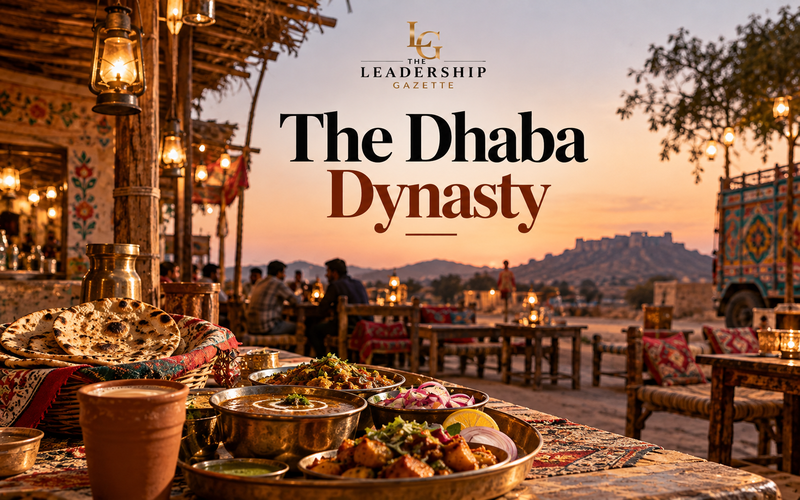
How Roadside Kitchens Along GT Road Built the Soul of Punjabi Food
From truck stops to tasting menus — the unlikely rise of Punjab’s most powerful
culinary institution
There is a particular sound that announces a dhaba before you ever see it. It is the slap
of dough against a hot tandoor wall, arriving through the dark in rhythmic, unhurried
beats, long before the charpoys and the string of bare bulbs come into view. On the
Grand Trunk Road, that sound has been playing on a loop for the better part of a
century, and it has done more to shape how India eats than almost any restaurant,
cookbook, or celebrity chef.
It is worth sitting with that claim for a moment, because it sounds like an exaggeration
until you actually trace the lineage. Butter chicken, dal makhani, tandoori roti, the entire
vocabulary of what most of the world now calls “Indian food” in restaurants from
London to Los Angeles — nearly all of it can be walked back to a handful of
unpretentious roadside kitchens that existed to do one job: feed truck drivers moving
goods along one of the oldest trade routes on earth.
That is the story most people don’t know about Punjab’s food scene, and it is the one
worth telling first.
A Road Older Than the Nation It Runs Through
The Grand Trunk Road predates the idea of Punjab as we know it, let alone the idea of
India or Pakistan. Sections of it have carried traders, armies, and pilgrims since before
Sher Shah Suri formalised and extended it in the sixteenth century, linking Bengal to
Kabul through the Punjab plains. Wherever a trade route runs for that long, an economy
of hospitality grows up around it — places to rest the animals, refill the water, eat
something hot, and move on before dark.
The dhaba, in its modern form, is the twentieth-century descendant of that older
economy. But it took a very specific, very Punjabi set of ingredients to turn a truck stop
into a cultural institution: a tandoor, a joint family willing to run it around the clock,
and a trucking economy that exploded after Partition and independence, as Punjab
became the country’s engine room for wheat, machinery, and freight moving across the
north.
Truck drivers do not eat like tourists. They eat like people who have another twelve
hours of driving ahead of them, who need food that is fast, filling, hot, and cheap, and
who will remember — and return to — the dhaba that got the daal right. That single fact,
repeated at thousands of stops for decades, is what quietly standardised and refined an
entire regional cuisine. The dhabas that survived were the ones that got very good at a
very small menu, night after night, truck after truck, for an audience with zero patience
for mediocrity and zero loyalty beyond taste.
The Tandoor as the First Boardroom
Every dhaba is built around its tandoor the way a newsroom is built around its printing
press. It is the asset, the identity, and often the only piece of equipment that matters. A
clay oven sunk into the ground, fired with wood or coal, capable of turning out roti,
naan, and tandoori meats at a punishing pace — the tandoor is what let dhabas serve
volume without sacrificing the smoky, charred flavour that has since become shorthand
for “authentic” Punjabi cooking anywhere in the world.
It is not an accident that the food which travelled furthest from Punjab’s dhabas was
tandoor food. It travels well conceptually because it was built, from day one, to be fast
without being lazy — a discipline that any operator running a high-volume business
would recognise immediately. There is a reason hospitality consultants studying quick-
service formats occasionally point to the dhaba model: a tight menu, a single high-
throughput cooking method, and food designed to be consistent at 2 a.m. as much as at
2 p.m.
From Roadside to Refined
The migration of dhaba food into formal dining is not a recent trend — it is closer to
seventy years in the making. When Partition scattered families and chefs across new
borders, some of the most influential names in what became “Punjabi restaurant food”
carried tandoor techniques with them into cities, formalising roadside recipes into what
we now recognise as North Indian restaurant cuisine. Dishes that began as ways to use
up the tandoor’s leftover tomato gravy and butter, or to stretch dal through a long
night’s service, were refined, plated, and eventually exported — until they became the
default idea of Indian food for entire generations of diners who had never been within a
thousand kilometres of a truck route.
That journey has not stopped. Today, a new generation of Punjabi chefs — many of them
trained abroad, some of them running fine-dining rooms in Chandigarh, Delhi, Dubai,
and further afield — are doing the reverse migration: taking dhaba dishes back out of
nostalgia and putting them, quite deliberately, on tasting menus. Smoked dal cooked
overnight the traditional way. Tandoori preparations built around single-origin spice
blends. Even the humble dhaba-style egg curry, once a trucker’s protein fix, now shows
up reinterpreted on menus with wine pairings.
What is striking is how little the underlying logic has changed. The chefs doing this
reinvention are not distancing themselves from the dhaba; they are crediting it, openly,
as the source. In an industry that often prizes invention over inheritance, that is a
notable and very Punjabi kind of confidence — the sense that the roadside version was
never the lesser version, just the original one.
A Business Story as Much as a Food Story
There is a leadership lesson tucked inside all of this, and it is one worth pulling out
explicitly. Dhabas are, almost without exception, family businesses — often multi-
generational, often run with a division of labour that would look familiar to any founder:
one person on the tandoor, another managing supply and cash, a third handling the
relentless, unglamorous work of keeping regulars happy. They operate with brutal focus
on unit economics long before anyone in the family would use that phrase — thin
margins, high volume, low waste, and a menu that rarely changes because changing it
would mean relearning what already works.
That discipline, built out of necessity on a highway shoulder, is precisely what today’s
hospitality entrepreneurs — from cloud kitchen founders to award-winning
restaurateurs — are still trying to formalise into playbooks. The dhaba got there first,
without a consultant in sight.
Why This Matters Now
Punjab’s food scene is having a genuine moment — new fine-dining rooms, a growing
wine culture around Chandigarh and Mohali, chef-led ventures reworking classics for
health-conscious diners, and a diaspora reinvesting in food brands back home. All of it
is worth covering, and this editorial section will. But none of it exists in a vacuum. Every
one of those newer stories is, in some way, still standing on a foundation poured decades
ago by families running kitchens out of roadside shacks along GT Road, one truckload of
hungry drivers at a time.
The next time a plate of butter chicken or a wedge of tandoori roti arrives at a five-star
table, it is worth remembering where the recipe actually clocked in for its first shift. Not
in a professional kitchen. On a highway, after dark, to the sound of dough hitting a hot
clay wall.