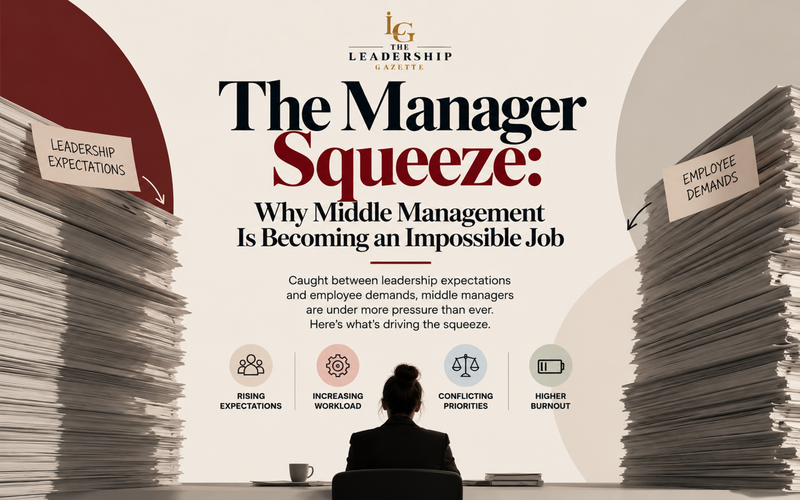
Middle managers are expected to carry strategy, culture, performance, wellbeing and transformation—often with less time, fewer resources and more people to lead.
The organisation keeps adding responsibilities to the manager’s job. Almost nobody asks what should be removed.
There is a familiar moment in many organisations. Senior leadership announces a new strategic priority. HR translates it into a people programme. Employees are told why it matters. Then the practical responsibility for making it work lands with the middle manager.
The manager must explain the change, answer questions, absorb frustration, maintain performance, identify resistance, protect morale and report progress—while continuing to deliver the targets that existed before the announcement.
This is not one exceptional quarter. It is increasingly the shape of the job.
Gallup’s 2026 workplace research found global manager engagement at 22% in 2025. Its research also shows that the average number of direct reports in the United States rose from 10.9 in 2024 to 12.1 in 2025, nearly 50% higher than when Gallup first measured it in 2013. The precise numbers will differ across markets, but the organisational pattern is recognisable: wider teams, continuous disruption and managers carrying responsibilities once distributed across several functions.
The job has expanded without being redesigned
Middle management used to be described as the layer that converted strategy into execution. That description now feels almost quaint. Managers are expected to be coaches, culture carriers, performance specialists, change leaders, wellbeing sentinels, inclusion advocates, technology adopters and sources of emotional stability.
Each expectation sounds reasonable in isolation. Together, they create a role that few people could perform well without trade-offs.
When organisations remove layers to become leaner, the work rarely disappears. It moves sideways or down. A manager inherits more direct reports, more administration and more decisions. At the same time, central functions introduce new processes that require the manager to complete another form, attend another briefing or hold another conversation.
The result is a peculiar form of organisational dishonesty: the company talks about empowering managers while steadily reducing the time and discretion they need to manage.
Training cannot compensate for a badly designed role
When managers struggle, the usual response is development. They are enrolled in programmes on feedback, resilience, difficult conversations, psychological safety and leading change.
Some of that training is valuable. But it also allows the organisation to treat a structural problem as a capability problem. A manager with 18 direct reports, six transformation projects and three hours of weekly reporting does not necessarily need a better time-management course. The role itself may be unmanageable.
CHROs should be careful about turning every organisational failure into a request for managers to become more skilled. Before commissioning another programme, ask whether expectations are coherent, whether decision rights are clear and whether managers have enough capacity to apply what they are being taught.
Managers have become the shock absorbers of change
During uncertainty, employees often look to their immediate manager before they look to the chief executive. The manager is expected to interpret incomplete information and make a distant corporate decision feel workable at team level.
That makes managers essential to change—and unusually exposed to it. They hear employee concerns that senior leaders never encounter. They must defend decisions they did not make and may not fully understand. If they express doubt, they risk appearing uncommitted; if they repeat polished messages without conviction, employees notice.
The strongest managers do not merely pass information downwards. They carry intelligence upwards. They know which parts of a transformation are creating friction, which employees are close to leaving and where an apparently minor process is damaging performance. Yet many organisations use managers as broadcast channels rather than sources of judgement.
AI will not automatically make management easier
AI may remove administrative work, prepare summaries and help managers identify patterns. It may also create more output to review, more decisions to validate and new questions about accountability.
A manager may soon allocate work between employees, contractors, automation and AI agents. That is not simply a productivity decision. It affects learning, fairness, job design and risk. The manager remains answerable when the technology produces a poor result, even if they did not select the system or define its guardrails.
If organisations use AI to widen spans of control further, they may discover that information is easier to process but people are not. A machine can summarise 20 performance conversations. It cannot build the trust that makes those conversations honest.
What CHROs should redesign
The first question should not be, ‘How do we make managers more resilient?’ It should be, ‘What have we made managers responsible for, and is that combination still sensible?’
Review spans of control by the complexity of work, not only the number of employees. Clarify which decisions managers genuinely own. Remove reports that nobody uses. Give managers direct access to specialist support for complex employee matters. Measure the administrative load created by HR itself.
Most importantly, distinguish management from individual contribution. Too many organisations promote strong specialists because management is the only available route to status and pay. They then lose an excellent specialist and gain a reluctant manager.
Middle managers are not a delivery mechanism with unlimited capacity. They are the point where strategy either becomes credible—or quietly falls apart.
If every important initiative depends on managers, protecting their capacity is not an HR benefit. It is an operating necessity.