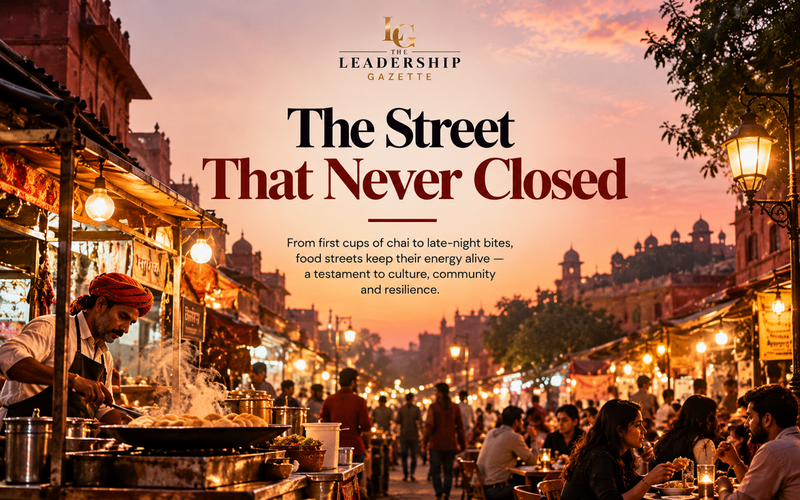
Most businesses that claim a three-century legacy are exaggerating for effect. Chandni Chowk is not. Somewhere in the lanes behind the Fatehpuri Masjid, a jalebi is still being fried in a kadhai the same way it was when the street was laid out under Emperor Shah Jahan in the 1650s, planned by his daughter Jahanara as a moonlit market of canals and courtyards. The canals are gone. The empire that built them is gone. The jalebi is not. That single fact — continuity across empires, invasions, a partition, and a republic — is what makes Chandni Chowk less a food street and more a functioning economic institution that happens to serve food.
It is worth treating it that way, because the numbers alone are unlike anything else in Indian hospitality. There is no reliable count of how many food businesses operate across Chandni Chowk’s tangle of lanes today, but estimates from traders’ associations routinely run into the thousands once every stall, cart, and shopfront is counted. Several of the best-known names — Parathe Wali Gali’s fried-bread specialists, the sweet shops around Dariba Kalan, the kebab houses of Jama Masjid’s edge — have been under the same family’s control for four, five, sometimes six generations. In an industry where most restaurants do not survive a decade, that is not a curiosity. It is a business model worth studying.
A Market Built Backward From Royalty
Chandni Chowk’s food economy did not emerge organically from street hawking the way many Indian food streets did. It was, at least at the top, seeded by royal patronage. Mughal kitchens demanded specific ingredients, specific sweets for court occasions, specific meat preparations for specific festivals — and the artisans who supplied that demand set up permanent shop in the lanes surrounding the Red Fort and Jama Masjid. When the empire’s direct patronage eventually faded, the shops did not. They had already built a second customer base among the city’s traders, pilgrims, and increasingly, ordinary Delhi residents who wanted a taste of what had once been reserved for the court.
That downward migration — from royal kitchen to public lane — is the opposite of how most food trends move today, where restaurant chefs borrow from the street and elevate it. In Chandni Chowk, the street elevated itself by outlasting the palace that once employed its ancestors.
The Guild Logic Nobody Wrote Down
Ask any long-standing Chandni Chowk shop owner how the street organizes itself and you will get some version of the same answer: informally, but with rules everyone follows anyway. Certain lanes specialize — Paranthe Wali Gali for stuffed fried breads, Dariba Kalan for sweets and silver, Gali Kababian for kebabs — not by municipal decree but by a century-plus of accumulated reputation that no new entrant can easily dislodge. A shop’s exact recipe, the specific ratio of ghee to flour, the precise spice blend for a particular kebab, is treated with the same protectiveness a modern company might apply to a patent, except it is protected purely through family secrecy, passed down orally and never fully written in one place.
This is, in effect, an unregulated guild system that has run for longer than most formal trade bodies in the country — self-policing on quality, fiercely competitive on reputation, and almost entirely resistant to outside capital trying to buy its way in. Attempts by larger restaurant groups to replicate a Chandni Chowk shop’s exact product elsewhere in Delhi have a long history of falling short, and locals will tell you, bluntly, why: the recipe was never really the whole business. The location, the decades of walk-in trust, and the family’s willingness to stand at the same counter every single day are not transferable assets.
Surviving Every Disruption Except the Latest One
Chandni Chowk’s food economy has technically survived the decline of the Mughal empire, the 1857 uprising and its brutal aftermath in the walled city, Partition’s mass displacement of both customers and shopkeepers, and decades of chronic civic neglect that left the street’s infrastructure crumbling even as its shops kept running. What has proven far harder to survive gracefully is modern urban redevelopment. The Delhi government’s pedestrianisation project, aimed at easing the area’s infamous congestion and improving safety, has reshaped footfall patterns in ways some shop owners say helped business and others say hurt it, depending on whether their lane benefited from the new walking traffic or lost the vehicle-based customers who used to stop briefly on the way through.
Rising commercial rents in a shrinking walled city, e-commerce eating into the adjoining wholesale trade that used to bring buyers into the food lanes as a side visit, and a labour shortage as younger family members increasingly choose careers outside the family shop are the quieter, less photogenic threats. None of them are dramatic enough to make headlines the way a fire or a demolition would. All of them are slowly changing who is still standing behind the counter a generation from now.
Succession Without a Playbook
For a Leadership Gazette readership, the most instructive part of Chandni Chowk’s story may not be the food at all — it is the succession model. These are, almost universally, businesses with no formal governance structure, no written succession plan, and no outside board to answer to, and yet many have transferred leadership across five or six generations without collapsing. The mechanism is apprenticeship disguised as childhood: sons and daughters (increasingly, in some shops, daughters as well) grow up behind the same counter, learn the exact temperature of the same kadhai, and absorb decades of customer relationships simply by being present for them.
It is a model that would horrify a management consultant and yet has outperformed almost every formally governed hospitality business in the country on the one metric that matters most: longevity. The lesson is not that formal succession planning is unnecessary. It is that trust, apprenticeship, and physical presence at the point of sale can substitute for a governance chart when a family is disciplined enough to keep showing up, decade after decade.
What a Culinary Icons Edition Would Actually Be Recognising
Any future awards or recognition effort built around Old Delhi’s food economy would have to grapple with something Rajasthan’s havelis and Punjab’s dhabas do not force as directly: shops here are not really competing for a customer’s first visit. They are competing to remain the version of a dish that a family has trusted for three generations, in a market where trying a competitor down the same lane is one open-air walk away. Recognition here carries a different weight — less “best new discovery,” more “continuing to earn the loyalty that outlasted an empire.”
Three hundred years from now, whatever remains of today’s Delhi will likely look nothing like the walled city Shah Jahan and Jahanara laid out. It is a reasonably safe bet that somewhere in what is left of it, a family will still be frying the same jalebi, in roughly the same way, for a customer who walked past a dozen other options to get there on purpose.