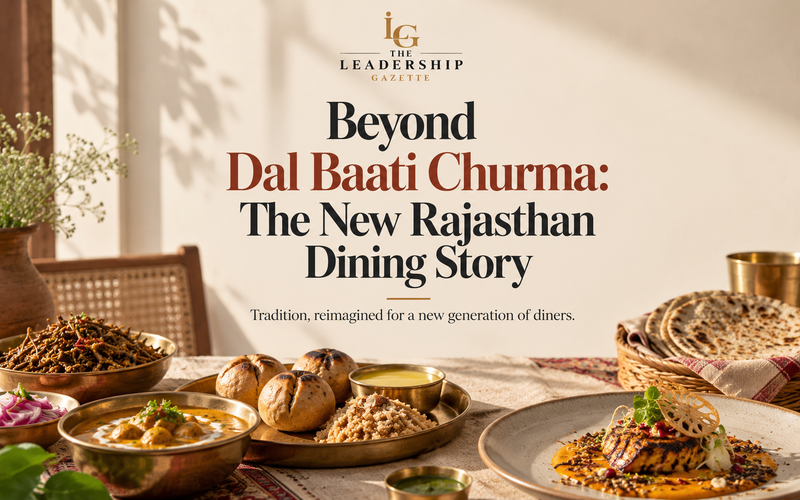
A new generation of chefs and restaurateurs is discovering that Rajasthan’s culinary future may depend on looking more closely at its past.
Ask a visitor to name Rajasthani food and the answer often arrives as a neat trio: dal, baati and churma. It is a magnificent meal, but it has also become a kind of shorthand – useful, recognisable and far too small for the culinary world it is expected to represent. Rajasthan’s food is not one cuisine. It is a collection of landscapes, communities, faiths, seasons and survival strategies, each of which has left something on the plate.
The more interesting dining story emerging across the state is therefore not about abandoning tradition. It is about widening the frame. Chefs are beginning to look beyond the dishes that fit easily on a tourist menu and towards the ingredients, techniques and domestic memories that rarely leave the home kitchen. That shift could give Rajasthan something more valuable than another fashionable restaurant trend: a modern food identity rooted in place.
A cuisine shaped by constraint
Rajasthani cooking is often described through scarcity: little water, punishing heat and limited access to fresh vegetables in many areas. But scarcity does not adequately describe the ingenuity involved. Drying, fermenting, pickling, slow cooking and using dairy or gram flour in multiple forms were not culinary curiosities. They were intelligent responses to climate and geography.
Ker and sangri could be stored and revived long after fresh produce disappeared. Bajra could withstand conditions that defeated more delicate grains. Gatte turned besan into substance; papad and mangodi allowed the pantry to carry a household through lean periods. Rajasthan Tourism’s own overview includes familiar dishes such as gatte ki khichdi and safed maas alongside dal baati churma, but even that official list can only hint at the variations found between Marwar, Mewar, Shekhawati, Hadoti and tribal belts.
This matters because the best modernisation begins with understanding why a dish exists. Replace an ingredient merely because it appears rustic and the result may be attractive but hollow. Understand the technique, the season and the household logic behind it, and reinterpretation becomes a conversation rather than a costume change.
The danger of the “royal” menu
For decades, Rajasthan has been sold through palaces, forts and royal kitchens. That has produced memorable dining experiences and helped preserve dishes such as laal maas and safed maas. It has also narrowed the public imagination. The food of courts is only one part of the state’s culinary inheritance. Merchant communities, pastoral groups, farming households, temple kitchens, Muslim cooks, Jain families, street vendors and sweet-makers have all shaped how Rajasthan eats.
A restaurant that calls itself Rajasthani but offers only a grand thali and two meat curries risks repeating the postcard version of the state. The more compelling restaurants are likely to ask harder questions. Which dishes belong to ordinary weekday meals? What do people eat during the monsoon? Which recipes are associated with childbirth, fasting, weddings or travel? What did a grandmother make with leftover rotis? Which flavour belongs to a particular town rather than to Rajasthan as a whole?
Modern does not have to mean miniature
There is a predictable way to make regional food look contemporary: reduce the portion, add a smear of sauce and serve it on a dark plate. That can be fun, but plating is not the same as progress. Modern Rajasthani cuisine becomes more meaningful when a restaurant improves ingredient sourcing, records oral recipes, credits communities, explains regional context and makes traditional dishes desirable to diners who did not grow up with them.
The opportunity is especially strong for vegetarian cooking. Long before “plant-forward” became a global restaurant phrase, Rajasthan had built elaborate meals around pulses, grains, dairy, spices and preserved vegetables. Bajra, moth beans, chaach, garlic chutneys and seasonal greens offer chefs a vocabulary that is both local and surprisingly current. Jain traditions add another body of technique that deserves treatment as cuisine, not merely as a list of exclusions.
Non-vegetarian food deserves the same breadth. Laal maas has become famous, but an honest exploration of regional meat cookery would include differences in household recipes, hunting histories, spice choices and the role of smoke, yoghurt and slow heat. The challenge is to present that history without romanticising violence, class privilege or a past that was not experienced equally by everyone.
The restaurant as archive
Restaurants cannot preserve an entire culture, and they should not pretend to. They can, however, become useful archives. A menu can name the town or community from which a preparation comes. A chef can collaborate with home cooks instead of quietly extracting their recipes. A restaurant can purchase desert produce from growers at a fair price and explain why that ingredient matters. A young cook can learn a traditional technique before it disappears with the last person in the family who knows it.
This is also good business. Diners increasingly seek variety and experiences with a clear point of view. The Bain-Swiggy study on India’s food-services market found that customers use multiple cuisines and restaurants across different occasions, while younger consumers account for a large share of consumption. A generic menu competes largely on convenience and price. A restaurant with a specific voice gives people a reason to remember it.
A wider Rajasthan on the plate
The next chapter of Rajasthani dining will not be written by rejecting dal baati churma. It will be written by refusing to let three dishes carry the burden of an entire state. The real opportunity lies in the foods that have not yet become symbols: the winter preparations, village breakfasts, community sweets, desert berries, forgotten grains, home-style gravies and techniques still passed by demonstration rather than recipe.
If chefs approach this inheritance with curiosity rather than nostalgia, Rajasthan can offer diners something richer than heritage as spectacle. It can offer a living cuisine – one confident enough to change because it knows what it is changing from.