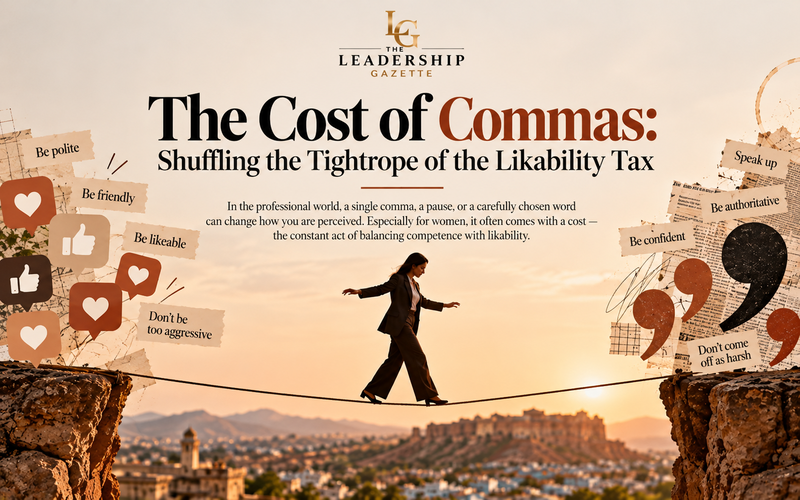
The Cost of Commas: Shuffling the Tightrope of the Likability Tax
The clock on the wall reads 6:45 PM. The office is mostly quiet, save for the rhythmic clicking of keys in the corner office. Maya, a senior director who just closed a major regional acquisition, stares at a three-sentence email draft on her screen.
The first version is crisp, clear, and perfectly efficient:
“I need the updated financial forecast by Thursday morning to finalize the board deck.” |
She hovers her mouse over the send button. Then, she hesitates. She deletes the period. She adds an exclamation mark. She pads the corners. The version she actually sends reads:
“Just checking in! Would it be possible to share the updated financial forecast by Thursday morning if you have a moment? Thank you so much! 😊” |
A firm directive is repackaged as a polite request. This isn’t timidity; Maya manages hundreds of people and negotiates multi-million dollar contracts. It is self-defense. She has learned the hard way that in the corporate lexicon, a man’s “decisive direction” is frequently translated as a woman’s “aggressive demand.”
The Invisible Unpaid Job
For women in leadership, professional life often requires running two businesses simultaneously: the actual corporation, and the delicate management of everyone else’s comfort regarding their authority. This psychological overhead is structurally recognized as the likability tax.
Sociologists and workplace psychologists have documented this double-bind for decades. When women exhibit stereotypical “agentic” leadership traits—such as assertiveness, independence, and sharp focus—they routinely face cultural backlash for lacking warmth. In practice, demonstrating the exact competence required to get through one corporate door makes the next one harder to open. The tax must be recalculated constantly:
- How direct can I be in this meeting without being tuned out?
- If I don’t smile while delivering this critique, will the team focus on the data or my temperament?
The Performance Review Trap
The most explicit evidence of the likability tax surfaces during annual calibration cycles. When male executives fall short, their feedback is typically actionable and objective: improve financial modeling accuracy, delegate operational workflows, or accelerate pipeline reporting.
For women, the critique frequently shifts from the work to the persona. High-performing female leaders find their evaluations saturated with subjective adjectives: “abrasive,” “intimidating,” “too intense,” or “lacking warmth.”
These moving goalposts create a psychological trap. If a leader adjusts her style to placate the feedback, she is often dismissed as lacking “executive presence” or authenticity. If she maintains her posture, she is labeled “uncoachable.”
Reclaiming the Terms of Leadership
Dismantling this framework requires shifting the burden away from individual women and onto institutional processes. True systemic progress occurs when organizations enforce managerial discipline:
- Demand Specificity: When subjective terms like “intimidating” or “difficult” are used in feedback, leadership must enforce immediate clarification: What was the exact behavior? What was the measurable impact? What would an alternative effective behavior look like?
- De-escalate Tone Policing: Filter out pre-apologies (“Sorry, just a quick thought…”) and recognize that accountability is naturally uncomfortable, regardless of the gender of the person delivering it.
- Audit the Vocabulary: Compare performance evaluations across identical pay grades to track whether outcomes or personalities are being graded.
True leadership diversity is reached when a woman can say “no” without constructing an accompanying essay, challenge a strategy without spending the next week repairing egos, and be respected by peers who may not find her explicitly pleasant.