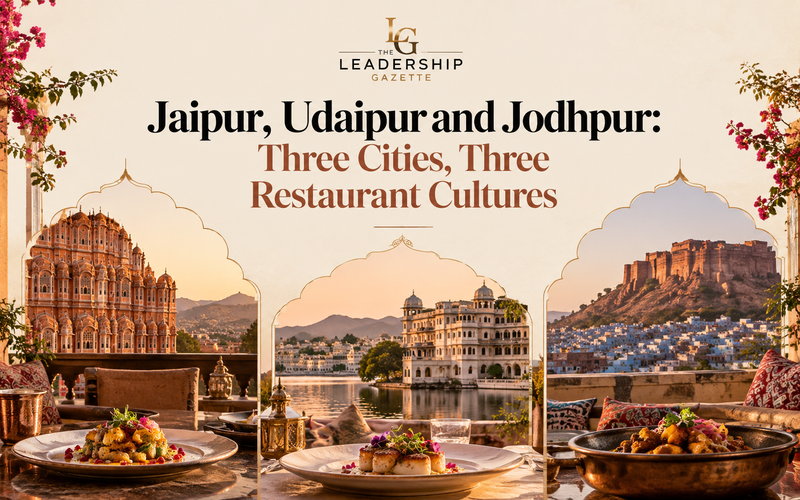
Rajasthan’s best-known cities share a tourism map, but their restaurants serve three very different markets.
On a Rajasthan itinerary, Jaipur, Udaipur and Jodhpur are often placed in the same sentence. On the ground, they eat very differently. Jaipur behaves increasingly like a large urban market. Udaipur sells the romance of the meal as much as the meal itself. Jodhpur remains more closely tethered to regional identity, legacy establishments and a smaller circle of repeat customers.
These are broad tendencies, not rigid categories. Every city contains exceptions. Yet the differences matter to anyone trying to understand Rajasthan’s restaurant culture, because a concept that thrives beside Jaipur’s office districts may make little sense on an Udaipur lakefront; a menu built for destination tourists may struggle to earn weekly loyalty in Jodhpur.
Jaipur: the restless metropolitan table
Jaipur has the deepest and most varied restaurant market of the three. It serves residents, students, professionals, wedding groups, domestic tourists and international visitors. That mix supports everything from neighbourhood cafés and mithai institutions to cocktail-led restaurants, hotel dining rooms, delivery-first kitchens and ambitious chef-driven concepts.
The city’s advantage is frequency. A tourist may dine once; a resident can return every week. That gives Jaipur operators room to build businesses around breakfast, work meetings, coffee, family dinners and late-night occasions rather than relying solely on sightseeing traffic. It also raises expectations. Diners compare a new Jaipur restaurant not only with local competitors but with what they have experienced in Delhi, Mumbai, Bengaluru or overseas.
The result is a market in motion. Design travels quickly through social media, menus absorb national trends, and novelty can create immediate queues. But Jaipur also exposes weak concepts quickly. A beautiful room may generate opening-month attention; it cannot conceal slow service, erratic food or a confused price proposition for long. Jaipur’s restaurant culture rewards reinvention, but it demands repetition: the second and fifth visits must work after the first photograph has been posted.
Udaipur: dinner as a destination
Udaipur’s defining restaurant asset is its setting. Water, palaces, terraces, old-city lanes and the Aravalli landscape turn an ordinary meal into an occasion. Tourism data and recent official reporting show the strength of Rajasthan’s visitor economy, and Udaipur’s appeal places restaurants inside that wider experience. For many guests, dinner is not simply where they eat after sightseeing; it is part of why the day feels memorable.
This creates a powerful premium, but also a trap. When the view is exceptional, kitchens can be forgiven more than they should be. Menus often become broad enough to satisfy mixed tourist groups, resulting in restaurants that serve Rajasthani, North Indian, continental and pan-Asian food without mastering any of them. The most interesting Udaipur restaurants are resisting that dilution. They understand that the location brings a guest once, but the food determines whether the experience is recommended.
Seasonality is particularly important. Demand can surge around holidays, weddings and Rajasthan’s cooler months, then soften sharply. A restaurant built only for peak-season traffic carries a different staffing and cash-flow challenge from a Jaipur neighbourhood business. Operators must decide whether they are primarily serving visitors, residents or both – and design the menu, price and service rhythm accordingly.
Jodhpur: identity before spectacle
Jodhpur’s dining character is less easily separated from its local food culture. The city’s reputation is built as much on snacks, sweets and long-standing establishments as on formal dining. Mirchi bada, mawa kachori and local namkeen are not side notes to the city’s food story; for many visitors and residents, they are the story.
That gives Jodhpur an authenticity advantage, although the word should be used carefully. A place is not authentic merely because it is old, inexpensive or unpolished. What Jodhpur possesses is continuity: businesses serving customers who know how a dish is supposed to taste, often across generations. Such diners are less impressed by reinvention for its own sake.
At the same time, heritage hotels and growing domestic travel are expanding the city’s formal dining market. The opportunity is not to turn Jodhpur into a smaller Jaipur or a landlocked Udaipur. It is to build restaurants that understand the city’s own rhythm – its ingredients, appetite, service expectations and deep confidence in familiar flavours.
Three different tests of greatness
A strong Jaipur restaurant must remain relevant in a crowded, fast-changing urban market. A strong Udaipur restaurant must ensure the kitchen is worthy of the view. A strong Jodhpur restaurant must innovate without losing the trust of diners who carry a precise memory of local taste.
Across all three cities, the fundamentals remain unglamorous: consistent food, clean operations, thoughtful hospitality and fair value. Yet “fair value” itself changes by market. In a destination restaurant, guests may pay for architecture, privacy and atmosphere. In a neighbourhood restaurant, value is proven through reliability. At a legacy sweet shop, it may reside in a taste that has survived fashion.
The next map of Rajasthan dining
The state’s restaurant story should eventually extend beyond this famous triangle. Ajmer, Pushkar, Kota, Bikaner, Alwar, Bundi, Jaisalmer and emerging tourism centres have their own food economies. But Jaipur, Udaipur and Jodhpur offer a useful starting point because they demonstrate a larger truth: Rajasthan is not one dining market.
The restaurants most likely to endure will be those that read their city accurately. They will know whether they are selling discovery or familiarity, an evening out or a destination, a local ritual or a traveller’s memory. The address may say Rajasthan. The restaurant culture is unmistakably local.