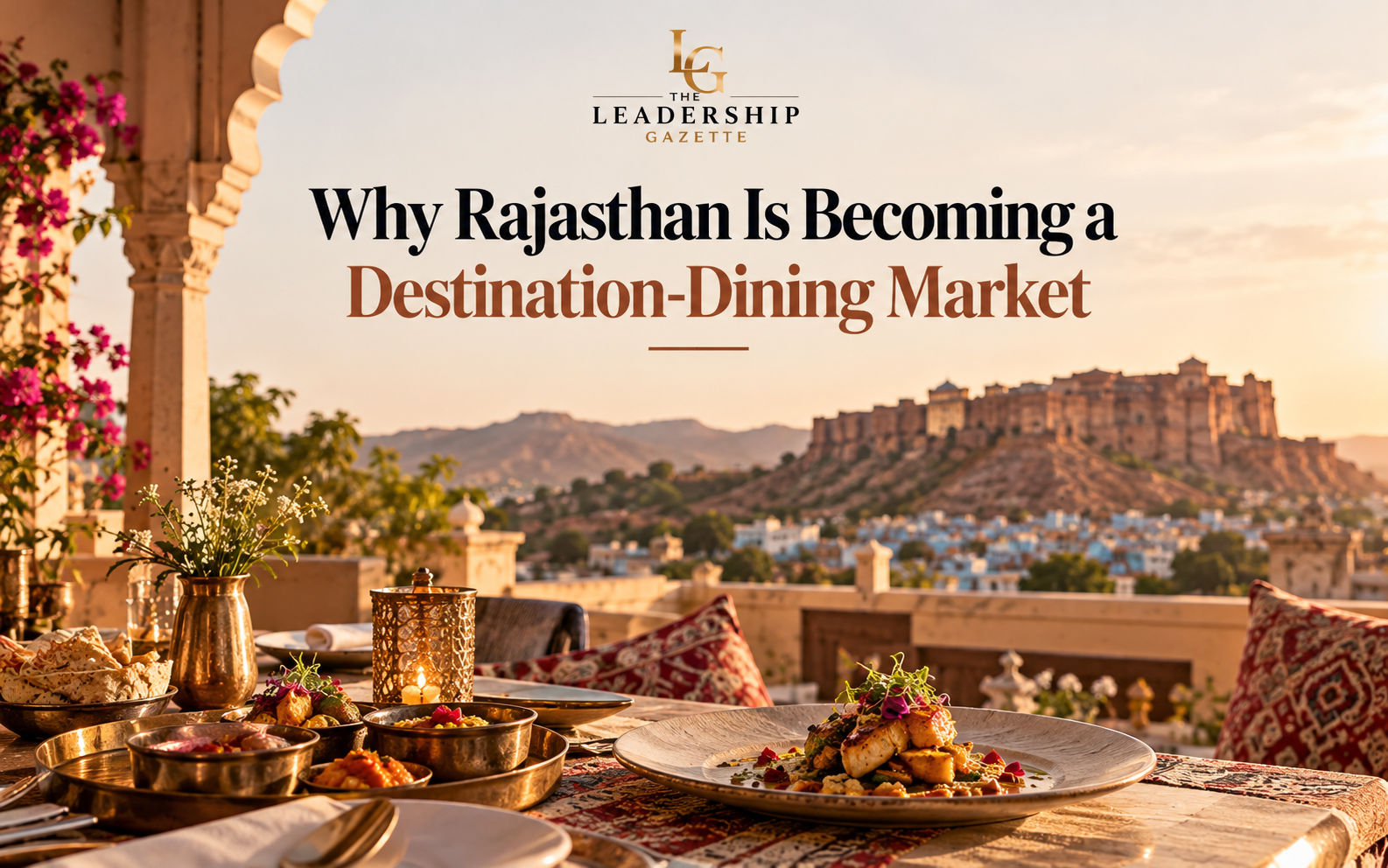
In Rajasthan, the setting has always been extraordinary. Now the opportunity is to
make the food compelling enough to become part of the journey.
There are meals people remember because the food was excellent, and meals they remember because
of where they were when they ate. Rajasthan has long excelled at the second kind. A terrace beneath a
fort, a table beside a lake, dinner in a restored courtyard or breakfast after a desert sunrise can make
even a familiar dish feel cinematic.
The next opportunity is more demanding: to make the restaurant itself worth travelling for. Destination
dining is not simply a restaurant with a beautiful address. It is an experience whose food, hospitality,
setting and story are strong enough to shape a journey. Rajasthan, with its heritage hotels, wedding
economy, distinctive regional cuisines and enormous visitor base, is unusually well placed to develop
this market.
Tourism is changing the audience
Rajasthan’s tourism economy is no longer sustained only by international travellers completing a palace-and-fort circuit. Domestic travel has expanded strongly, bringing repeat visitors, younger travellers, wedding guests, families and short-break tourists with different expectations. Official state reporting places tourism among Rajasthan’s major economic sectors, with Jaipur, Udaipur, Jodhpur, Jaisalmer and Ajmer among its best-known draws.
This audience does not necessarily want every meal to be a formal thali in a heritage dining room. It may seek a local breakfast, a café between sightseeing stops, a chef-led dinner, regional street food or a contemporary restaurant that could hold its own in any major Indian city while still feeling unmistakably Rajasthani.
That change opens space between two familiar extremes: the inexpensive “local famous” stop and the luxury hotel experience. Independent restaurants can occupy it by offering strong food, distinctive design and informed service without requiring palace-scale investment.
The setting is an asset, not a strategy
Rajasthan makes visual storytelling easy. Old stone, hand-painted walls, courtyards, terraces and desert light provide what operators elsewhere spend heavily trying to manufacture. The danger is assuming the setting completes the experience.
A restaurant built around a view may have little incentive to earn repeat business if new tourists arrive every evening. Menus become overextended, service turns transactional and food settles into acceptable predictability. The photographs remain beautiful while the meal becomes forgettable.
A true destination restaurant reverses that hierarchy. The setting creates anticipation; the food justifies it. The menu should have a reason to exist in that location. It might interpret Mewari ingredients beside an Udaipur lake, build a desert tasting menu outside Jaisalmer, explore Marwari household food in Jodhpur or bring Jaipur’s contemporary urban energy into a restored haveli. The connection need not be literal, but it should be legible.
Food as cultural access
Travellers increasingly use food to understand a place. A dish can explain climate, trade, faith, class, migration and memory more intimately than a monument label. Rajasthan’s preserved vegetables speak of aridity; its use of gram flour and dairy reveals adaptation; its meat dishes carry histories of courts and hunting; its Jain and Vaishnav traditions show how culinary complexity can develop within firm dietary boundaries.
Restaurants that communicate this context can deepen the tourist experience without turning dinner into a lecture. A well-trained server can explain why an ingredient is dried, where a chilli comes from or how a family recipe varies across districts. A concise menu note can credit a community or town. A tasting sequence can move through landscape rather than status.
The ethical line matters. Culture should not become décor detached from the people who sustained it. If a restaurant monetises a village technique or household recipe, it should consider collaboration, attribution and purchasing relationships that share value rather than merely borrowing a story.
Weddings, hotels and the search for the next meal
Rajasthan’s prominence as a wedding destination creates a particularly influential dining audience. Guests arrive ready to celebrate and spend, but banquet abundance can also produce sameness. The restaurant that offers a memorable meal before or after the wedding functions as an escape from the event as well as an extension of the trip.
Hotels are responding too. Once, a hotel restaurant could rely mainly on resident guests. Today, the stronger opportunity is to become relevant to the city itself. Local diners bring year-round demand, sharper feedback and word-of-mouth credibility. When residents recommend a hotel restaurant without mentioning the hotel, the venue has crossed an important threshold.
What Rajasthan still needs
For destination dining to mature, the ecosystem around the restaurant must improve. Reliable reservations, accurate opening hours, trained service teams, accessible menus, sensible transport information and consistent hygiene are not glamorous, but they determine whether anticipation becomes trust.
The market also needs serious food documentation. Too many restaurant descriptions repeat the same claims about royalty, secret spices and age-old recipes. Better storytelling begins with research: oral histories, ingredient trails, community knowledge and honest accounts of how a dish has changed.
A reason to add one more night
The most valuable destination restaurants change travel behaviour. They persuade a visitor to cross town, rearrange an itinerary or stay one more evening. That is the standard Rajasthan should pursue.
The state already possesses the architecture, hospitality traditions and global recognition. Its dining market will come of age when the meal is no longer treated as an accessory to the palace, lake or fort – but as a destination in its own right.